

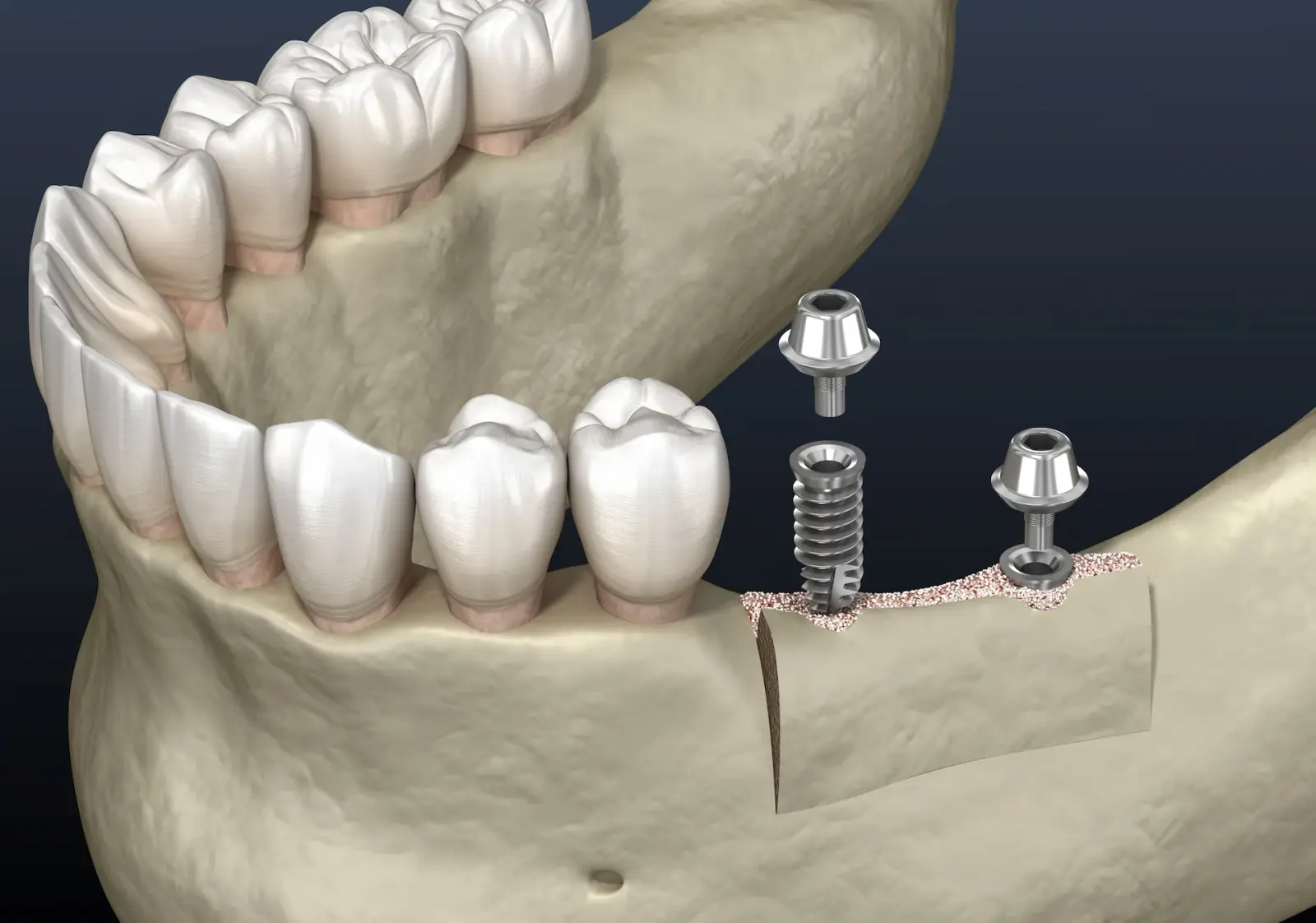
01. What Is Ridge Augmentation?
Ridge augmentation is a bone grafting procedure focused specifically on the alveolar ridge, the bony ledge that holds your tooth roots. After a tooth is lost or extracted, this ridge can resorb, becoming too narrow or too short to safely anchor an implant. During ridge augmentation, Dr. Gholami adds bone graft material to the ridge and allows it to heal and integrate before implant placement.
Ridge Augmentation vs. Other Bone Grafting Procedures
| Feature | Ridge Augmentation | General Bone Grafting | Sinus Lift |
|---|---|---|---|
| Where it's performed | The horizontal ridge where a tooth is missing | Various sites depending on the defect | The upper jaw near the sinus floor |
| What it addresses | Narrow or collapsed ridge width and height | A range of bone loss causes | Insufficient bone height in the upper back jaw |
| Common candidates | Patients with a long-missing tooth | Patients with bone loss from injury or disease | Patients needing upper back implants |
What Happens If You Skip Ridge Augmentation
Without enough ridge width or height, an implant may not have adequate bone to anchor into, which can lead to implant instability or failure. In some cases, placing an implant into an inadequate ridge can also leave the implant visible under thin gum tissue. Addressing the ridge first protects your investment in a long-term, stable result.
02. Your Ridge Augmentation Process at Riverwalk Dental
Step 1. Evaluation and CT Imaging
A cone beam CT scan lets Dr. Gholami measure the exact width and height of your ridge and determine how much grafting is needed before implant placement.
Step 2. The Ridge Augmentation Procedure
Dr. Gholami places bone graft material along the ridge, using your own bone, donor bone, or a synthetic substitute depending on your case. The site is closed and given time to heal.
Step 3. Healing and Implant Placement
Ridge augmentation typically needs four to six months to fully integrate before an implant can be placed. Once healing is confirmed, we move forward with your implant procedure.
03. Why Riverwalk Dental Group for Ridge Augmentation
Dr. Laya Gholami is a double board-certified periodontist and implant surgeon with advanced training in bone augmentation. Because she handles both the grafting and the implant placement in-house, you avoid the hassle of coordinating between separate specialists. We also offer sedation dentistry for anxious patients, and our team provides care in English and Spanish across all four of our South Florida locations.